
Coins in the £1 Category
 | Elizabeth II (1952-2022) | |
 | Charles III (2022-Present) |
Which £1 to look for?
The lowest mintage £1 are:(These are coins in our database, list may not be exhustive)
- 2011 One Pound Coin - Edinburgh (mintage: 935,000)
- 2011 One Pound Coin - Cardiff (mintage: 1,615,000)
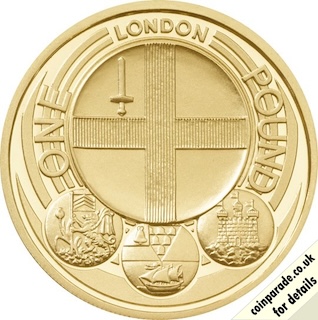
- 2010 One Pound Coin - London (mintage: 2,635,000)
- 2008 One Pound Coin - Royal Arms (mintage: 3,910,000)
- 2014 One Pound Coin - Thistle and Bluebell (mintage: 5,185,000)
- 2013 One Pound Coin - Leek and Daffodil (mintage: 5,270,000)
- 2013 One Pound Coin - Rose and Oak (mintage: 5,270,000)
- 2014 One Pound Coin - Flax and Shamrock (mintage: 5,780,000)
- 2010 One Pound Coin - Belfast (mintage: 6,205,000)
- 1988 One Pound Coin - Shield of the Royal Arms (mintage: 7,118,825)
How to collect £1
The main currency of the UK, the GBP £1 coin replaced the previous £1 banknote in April 1983. The round coin was replaced by a 12-sided one-pound coin in March 2017. Easy to collect, many of the early coins are still quite cheap. Many different and interesting Reverse designs.More Information about £1 coins for Collectors
The main currency of the UK, the GBP £1 coin replaced the previous £1 banknote in April 1983.
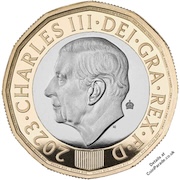
The British one pound (£1) coin is a denomination of the pound sterling. The Obverse of Elizabeth II coins bears the Latin engraving "Dei Gratia Regina" meaning, "By the grace of God, Queen", or for the King "Dei Gratia Rex" for "By the grace of God, Queen". The FD meaning "Defender of the Faith."
It featured the profile of Queen Elizabeth II when the coin was introduction on 21 April 1983. Four different portraits of the Queen were used:
- 1983-1984, Elizabeth II by Arnold Machin
- 1985-1997, Elizabeth II by Raphael Maklouf
- 1998-2015, Elizabeth II by Ian Rank-Broadley
- 2015-2023, Elizabeth II by Jody Clark
- 2023 to date, Charles III by Martin Jennings
The coin replaced the Bank of England £1 note, which ceased to be issued at the end of 1984 and was removed from circulation on 11 March 1988, though still redeemable at the Bank's offices, like all English banknotes. One-pound notes continue to be issued in Jersey, Guernsey and the Isle of Man, and by the Royal Bank of Scotland, but the pound coin is much more widely used.
The round coin is made in Nickel-brass (70% Cu, 24.5% Zn, and 5.5% Ni). Most years there has been a variant as silver, piedfort silver, gold and sometimes platinum.
At 31 March 2016 it was estimated that there were 1,671,328,000 pound coins in circulation. The Royal Mint estimated in 2014 that 3.04% (about 47 million) were counterfeit and mainly because of this it was decided to change the design. Note that even some of the uncirculated coins have been counterfeited so this is still a problem for collectors.
Most one pound coins have an edge inscription, although sometimes this has been replaced with incuse patterns. The common inscriptions are:
| Edge Inscription | Translation/etymology |
| DECUS ET TUTAMEN | 'An ornament and a safeguard' from Virgil's Aeneid |
| NEMO ME IMPUNE LACESSIT | 'No one provokes me with impunity'. The Motto of the Order of the Thistle |
| PLEIDIOL WYF I'M GWLAD | 'True am I to my country' from the Welsh National Anthem |
| PRO TANTO QUID RETRIBUAMUS | 'What shall we give in return for so much.' The Motto of Belfast |
| DOMINE DIRIGE NOS | 'Lord direct us.' The Motto of London |
| Y DDRAIG GOCH DDYRY CYCHWYN | ‘The Red Dragon shall lead’ The Motto of Cardiff |
| NISI DOMINUS FRUSTRA | ‘It is vain without the Lord’ The Motto of Edinburgh |
You may find these articles interesting if you like one pound coins:
Introduction to British Coins, which explains the UK currency both old and new.
Latin Inscriptions on British Coins which describes the Latin phrases on the legends of UK coins and their meaning.
History of the One-Pound Coin, a short hostory of the One Pound coin.
Production
All coins have been produced by the Royal Mint. The final 'round' coins were minted in December 2015. Their replacement, a new 12-sided design, was introduced from 28 March 2017 onwards. It is of a similar 12-sided shape to the pre-decimal brass threepence coin, is roughly the same size as the round £1 coin and is bimetallic like the current £2 coin. The new design was intended to make counterfeiting more difficult, via an undisclosed hidden security feature, called 'iSIS' (Integrated Secure Identification Systems).
To reach the initial production of 1.5 billion pound coins to replace the exsiting coins the Royal Mint used ten presses 24×7 making 140,000 coins per hour. It takes a long time to restock the entire country and that’s why the new coins were dated 2016 and 2017 despite not being legal tender until March 2017.
The old round one pound coin ceased to be legal tender on 15 October 2017.