
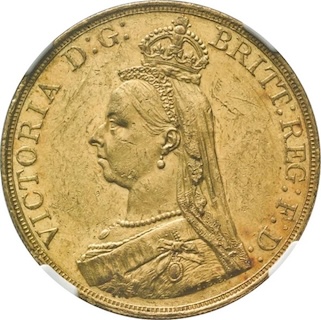
Coins in the Gold £5 Category
 | Victoria (1837-1901) | |
 | Edward VII (1901-1910) | |
 | George V (1910-1936) | |
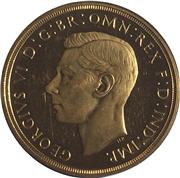 | George VI (1936-1952) | |
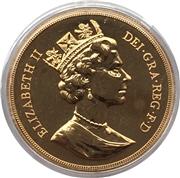 | Elizabeth II (1952-2022) | |
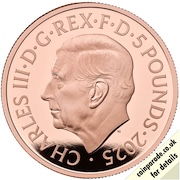 | Charles III (2022-Present) |
Which Gold £5 to look for?
The lowest mintage Gold £5 are:(These are coins in our database, list may not be exhustive)
- 2025 Coat of Arms Charles III Gold £5 Proof (mintage: 60)
- 2017 Gold 5 Pound King Canute (mintage: 150)
- 2021 Alfred the Great Gold £5 Proof (mintage: 170)
- 2020 Gold Proof 5 Pound Coin - Music Legends: Elton John (mintage: 250)
- 2022 Queen's Reign Honours and Investitures Gold £5 Proof - Awarding Honours (mintage: 268)
- 2020 Gold 5 Pound Coin - Five-Sovereign Piece BU (mintage: 350)
- 2021 Gold 5 Pound Coin - Five-Sovereign Piece BU (mintage: 410)
- 2019 Gold 5 Pound Coin - Five-Sovereign Piece BU (mintage: 500)
- 2017 Gold Proof Five Pounds Piece - Sapphire Jubilee (mintage: 650)
- 2019 Gold 5 Pound Coin - Queen Victoria 200th Anniversary (mintage: 725)
How to collect Gold £5
There are two basic kinds of gold five pound coin: the gold £5 (quintuple sovereign) type and the gold Crown. They are the same weight of gold and vary only slightly in diameter.More Information about Gold £5 coins for Collectors
Not that many people own Gold Five Pound coins, I suppose mainly because they are an expensive coin even in bullion form. Perhaps even fewer realise there are two basic kinds of gold five pound coin. They are very similar, yet distinct.The Gold £5 Coin
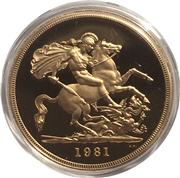
Often referred to as the non commemorative £5 coin or the Quintuple Sovereign as it is exactly five times heaver than a Sovereign (7.9881 x 5 = 39.94g). As one sovereign is nominally one pound then a quintuple sovereign must be five pounds.
The Gold £5 coin has its history deriving from the five guinea coin right back at the start of the 19th Century. In those days a guinea was valued at one pound rather than the one-pound-and-one-shilling it is often remembered as nowadays. George III, George IV and Victoria all issued actual gold £5 coins and others issued a few too, but Elizabeth II began the surge in production, especially from 1980 onwards. From 1990, the £5 coin was minted in Cupro-Nickel too and silver versions were also available.
The Gold Crown
The Crown is another English coin with a long history. You may remember the Half-Crown from pre-decimalisation days, but the Crown has been a commemorative coin for as long as we can remember. The Crown was legal tender at a quarter-pound, which was five shillings (25 pence in decimalised money).
In the Eighties we saw the introduction of the pound coin and the two-pound coin, so the Government decided that the crown needed to be restored to it former glory as biggest denomination coin and the crown was re-denominated to £5 in 1990.
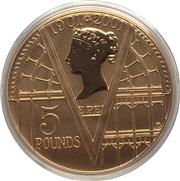
This re-denominated was OK by itself, but as a (still) mainly commemorative coin it was soon available not only as Cupro-Nickel but as silver and ... gold. That meant we had a new, official, gold £5 coin.
It also weighs 39.94g. And to prove its value it has '5 pounds' written on it.
The only difference between the sovereign gold £5 coin and the gold crown is the diameter. The crown maintained its original diameter of 38.61mm compared to the slightly smaller 36.613mm of the sovereign type.
The re-denominated had other effects too. Whether re-denominated is determined as from this point onwards or backward-compatible is unclear to many. The original crown was a gold coin, so does that mean that Henry VIII's gold crowns were the first £5 coins? So the history of coins starts to rewrite itself in some ways, although if this is intended or correct I'm not sure.
The Gold Five-Pound Piece
I've noticed many dealers referring to these coins as '£5 pieces'. Maybe it's a way of avoiding the confusion and grouping the coins into the same category rather than having them as two separate entities. Besides the slight difference in diameter (which is difficult to see as most of these coins are encapsulated in some way) there's little to tell.
If the reverse looks like it commemorated something then it's probably a crown. If the reverse is the same as the reverse of a sovereign of the same year then it could be a five pound coin. Whatever, you have a gold five pounds with almost 40g of gold; it's impressive and they are a great investment.
Five pound coins are often in 4- or 5-coin sets, together with combinations of a sovereign, half-sovereign, double sovereign, quadruple sovereign and maybe some commemorative item or a year-set collectable. They can be bullion, proof or matt-proof.
Despite the high intrinisic value and even higher collector value, five pound pieces are much sought after and are often sold out within days of release causing some of the coins to have a very high price tag.