
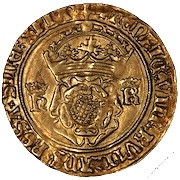
 The 1526-1533 Crown of the double-rose - Henry VIII (Second Coinage)
The Crown of the double-rose was a 22 carat gold coin denominated as 5 shillings. The letters H and K on the Obverse refer to Henry and Katherine of Aragon. Minted between 1526 and 1533 at the Royal Mint in London. Diameter about 25mm. Weight 3.69g.
The Crown of the double-rose (5 shillings) replaced the Crown of the Rose (4 shillings and sixpence) which was minted a few months earlier in 1526.
The Obverse shows a crowned double rose dividing the crowned letters H and K (for Henry and Katherine of Aragon). Mint mark is a rose. legend "HENRIC VIII RUTILANS ROSA SIE SPIN" meaning "Henry VIII a dazzling rose without a thorn".
The Edge is plain.
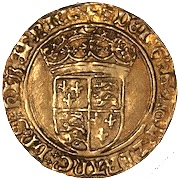 The Reverse shows a crowned shield quartered with the arms of England and France within a line circle. Legend around shows a mint mark of a rose, with legend "DEI G R AGL Z FRANC DNS HIBERNIE", meaning "By the Grace of God, King of England and France, Lord of Ireland".
On later coins the "hK" (for Henry and Katherine of Aragon) was later replaced with "hA" (for Anne Boleyn), "hI" (for Jane Seymour) or "hR" (Henry Rex). "hK" was also used for Katherine Howard.
There are variations, see SCBA 2273 to 2283, and North p1788.
Image credit: Museums Victoria
Mintage: Not known
Minted at The Royal Mint
More information (monarch, year, mint, country, category) can be found below coin listings.
Below are some coins currently being offered on eBay. As an eBay Partner, We may be compensated if you make a purchase.
List items on:
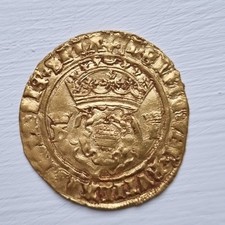 | Gold hammered coin , henry viii crown of the double rose. £ 4,586.70 |
| King Henry VIII Crown of the Double Rose , Jane Seymour £ 4,586.70 |
List items on:
Remember 1526 ?
Henry VIII (1509-1547)
Classification: House of Tudor. King of England. Hammered.Henry VIII was born in 28 June 1491, his parents being King Henry VII of England, Elizabeth of York. He became King in 1509 aged just seventeen.
Henry was well educated and athletic, standing six feet tall. Henry liked to have his own way and could ruthlessly enforce it, and in doing so blew the fortune left him by his Father. He split with the Pope who didn't allow him to divorce, leading the King to become the head of the Church of England. He built a large Navy and heavily debased the currency.
Henry VIII is perhaps most well know for having six wives: Catherine of Aragon (m. 1509; ann. 1533); Anne Boleyn (m. 1533; ann. 1536); Jane Seymour (m. 1536; d. 1537); Anne of Cleves (m. 1540; ann. 1540); Catherine Howard (m. 1540; d. 1542); and Catherine Parr (m. 1543).
Three of Henry's children had a turn on the throne: Edward VI, Mary I, and Elizabeth I.
Category: Crowns
The Crown is a very old coin, with origins dating back to Henry VIII. The English Crown first appeared in 1526. It was made of 22 carat gold ("crown gold") and has a value of five shillings (a quarter of a pound).By 1551, silver was being used to produce crowns, although gold was sometimes still used. The silver crown was quite large, being about 38mm and weighing about one ounce. Around that time many Europeans countries had similar sized silver coins which made them good for international trade as they were essentially interchangeable.
The metal used was 92.5% silver and the rest copper so as to make the coin harder. This hardness, together with a milled edge, made 'clipping' (which was cutting slices off the edge to steal some free silver) more difficult.
After the Union of England and Scotland in 1707 a new coin, the British Crown, replaced the English Crown and Scottish Dollar. The value was set at 5 shillings and the size was 38mm in diameter and weighed about 1oz as before.
Now more of a commemorative coin
Although the coin was always part of the British coin family, its large size made it unpopular for general circulation and the half-crown was favoured as the de-facto largest coin in circulation. The Crown was more-or-less relegated to a commemorative coin.
The British economy, especially after the World Wars, took its toll on the crown too. From 1816-1919 the crown was 0.925 silver, this was reduced to 0.500 silver in 1920 and in 1947 the Crown became Cupronickel (75% copper, 25% nickel). The size standardised at 38.61 mm and (silver crown) weight of 28.276g (1 oz).
Although not in current circulation, the Crown is still legal tender. After decimalisation in 1971 the Crown was officially valued at 25 pence. In the Eighties we had inflation which brought in higher denomination coins like the pound coin and the two-pound coin, so the Government decided that the crown needed to be restored to it former glory as biggest denomination coin and the crown was re-denominated to £5 in 1990.
Today the Crown is once again made in silver and gold, usually to satisfy collectors and investors. There is a little confusion with this as there are Gold Crowns which are worth £5 but there is another five-pound Gold coin from the sovereign family - see the article on Gold £5 Coin or Gold Crown?
Which Mint: The Royal Mint
The Royal Mint is the designated place for the UK to mint coins. It dates back well over 1000 years and is a Government-owned company. Formed in the reign of Alfred the Great about the year 886, during the period 1279-1812 it was generally referred to as The Tower Mint as it was housed at the Tower of London. The Master of The Royal Mint has included famous figures such as Sir Isaac Newton.
Since 2010 it has operated as Royal Mint Ltd, a company owned by HM Treasury, under an exclusive contract to supply all coinage for the UK although it also produces medals and coins for other countries. It is currently located at Llantrisant, Wales.
Country of Origin: United Kingdom
The United Kingdom (UK) is the Union of England, Scotland, Wales and Northern Ireland. It is often refered to as Great Britain (GBR). It has a long, rich history. The orignal coinage was Pounds, Shillings and Pence but since decimalisation on 15 February 1971, it is £1 = 100p, that is One Pound = 100 pence. The coinage of the UK is also a long history, the Royal Mint being established as long ago as 886AD when coins were hammered. Today there is perhaps 30 billion coins in circulation, and many (numismatic) collectors coins and sets are issued frequently in gold, silver and other metals.